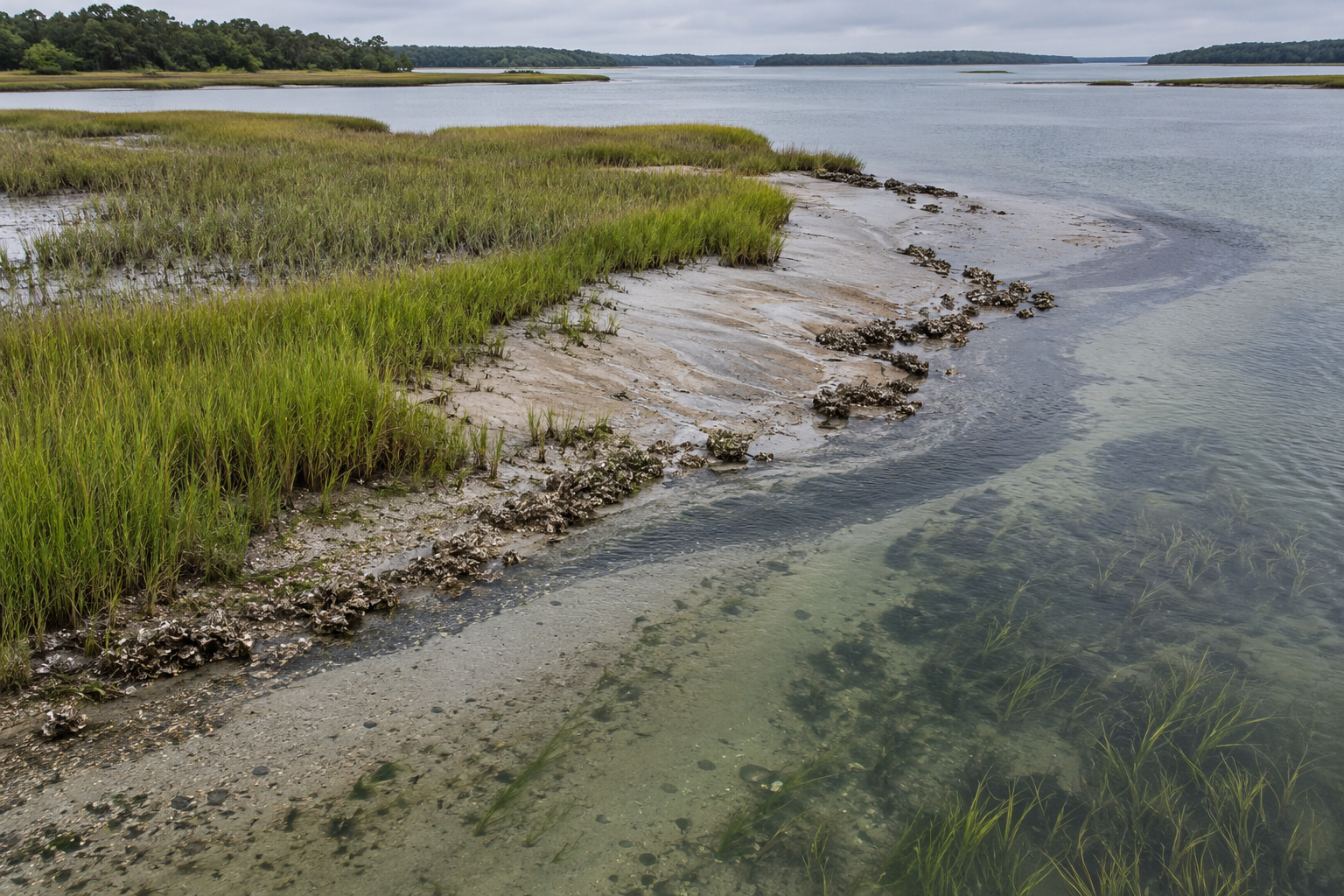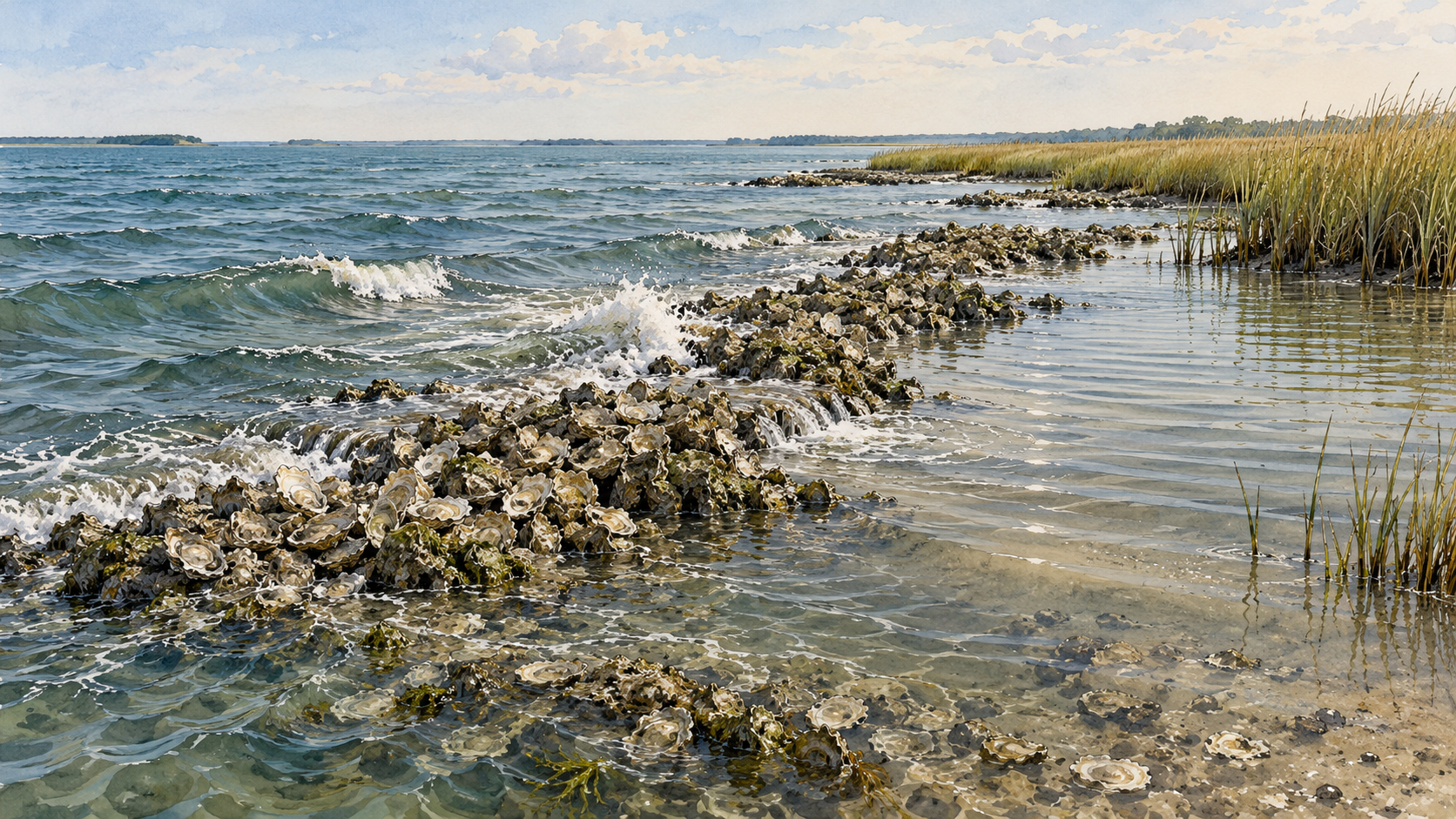
An oyster reef sits low enough that it can vanish beneath a high tide. When water covers it, the reef has not stopped working. A passing wave still meets a ridge of shells; tidal current still has to pass over, through, or around its uneven surface. The result is neither a wall nor a still pool behind it. It is a rearrangement of moving water, with different consequences at the crest, in the gaps, and on the sheltered side.
The shell structure matters. Living oysters attach to hard surfaces and to one another, building an irregular bed that rises above surrounding mud or sand. Water moving against that relief meets drag. Wave motion near the bottom rubs against the rough surface, and flow breaks into small turbulent motions around shell edges. In a 2024 wave-flume experiment, researchers compared artificial rough surfaces with sharp and blunt elements. Sharp-edged forms generated more turbulence and stronger wave dissipation in the tested conditions. The models were surrogates, not living reefs; they isolate one physical reason why a dense shell surface can change waves.
The height of the tide changes the answer
The most visible effect is often a lower wave on the landward side. As a wave meets a shallow reef, it may break, reflect in part, or lose energy to friction. How much gets through depends strongly on the water depth above the reef crest. Wiberg and colleagues measured waves on both sides of four restored intertidal reefs in Virginia coastal bays and at a nearby no-reef control. Their reefs reduced average wave height substantially when water depth was close to crest height. When water was much deeper, the measured reduction was small. The study gives a reason to ask where the crest sits in the tide, rather than assigning one permanent wave-reduction number to a reef.
A broader comparison of fifteen reef and control pairs along the US Atlantic and Gulf coasts reached a related, difficult design finding. Reefs that spent more time exposed above water cut waves more strongly during the deployments. Yet the structures with the greatest exposure fell outside the study's threshold for suitable oyster inundation. Reefs considered more suitable for oysters gave, on average, little extra wave reduction compared with their controls in the measured conditions. The authors' short deployments did not capture every storm. Their result still exposes a real tension: a high crest can interrupt waves, while living oysters need sufficient time under water to feed and grow.
The same tide dependence appeared in a different setting on a monsoon-influenced coast of Bangladesh. In an original field study of constructed oyster breakwaters, wave reduction changed with both water and wave height. When the reef stood high relative to the water, it strongly interrupted waves; at higher water, some waves crossed with much less reduction. Sediment changes behind those reefs were measured season by season. This does not supply a formula for another shore. It reinforces that the reef's effect belongs to a particular tide, incoming wave, and local bed.
Flow over the crest is different from flow beside it
Wave height is only part of the moving-water story. Tidal current can be slowed next to a reef while flowing faster over its crown or around an end. In two field studies of constructed reefs, Colden and colleagues compared water and seabed conditions across reefs set at different angles to tidal flow. Areas adjacent to the reefs had lower velocities and trapped finer sediment than off-reef reference areas. Above the crest, they observed higher velocities, more suspended particles, and evidence consistent with local erosion of fine material. A reef can therefore encourage settling in one pocket and keep sediment moving at its top. Calling the whole structure a current brake hides this unevenness.
The reef's alignment affected those patterns. In Colden's study, reefs perpendicular to the tidal current created conditions that tended to clear sediment from the crest more effectively than the other tested layouts. That matters to an oyster: a bare, hard shell face offers a different place to settle from one blanketed by fine mud. The observation is a field result from those particular constructed reefs, not a rule to rotate every reef perpendicular to a coast. Water approaches a real site from different directions with the tide and wind; one orientation will not serve every goal in the same way.
Field instruments at Gandys Beach, New Jersey, show how many processes can meet around a low reef. A US Geological Survey investigation placed wave gauges, current meters, sediment traps, and erosion pins around constructed oyster-castle structures during two winter months. Wave reduction varied with water depth and wave type. The researchers found that some swell energy crossed the structures with little damping even as local wind waves were affected. Currents and the shape of the nearshore bed also mattered. The reef altered the water reaching the marsh, but it did not turn every incoming wave into the same quiet ripple.
Slower water does not always mean a growing marsh
Where water slows, particles may settle. On the Bangladesh coast, the reef-side measurements found more sediment accumulation in sheltered mudflat areas than at controls during parts of the seasonal cycle. But sediment supply is itself useful to a marsh: a marsh platform needs material if it is to maintain its elevation. Reducing wave force and reducing sediment delivery can pull in different directions.
That tension appeared in a 2025 study of two constructed subtidal reefs made with oyster shell and limestone gravel at an eroding marsh shoreline. The structures lowered measured wave energy under some winds. The researchers also found a significant reduction in sediment deposition onto the marsh; the measured reduction in shoreline erosion was less clear. Those are results from a specific design and observation period, not proof that reefs generally starve marshes. They are a warning against judging success by a wave gauge alone. The shore behind the reef must receive enough sediment as well as enough relief from erosion.
Living oysters can change the engineering question over time. In a two-site field study published in 2025, researchers measured waves before and after oyster recruitment on breakwaters. After growth, wave attenuation increased; the authors linked the change to a rougher surface and less open space within the structures. The amount varied by site and by whether the reef was submerged or emerged. A design drawn as fixed blocks misses that a living reef can develop, while one that fails to recruit oysters may retain only its built skeleton.
Reading a reef's effect therefore takes paired views of the water and the shore. Gauges on both sides show which waves get through at different tides. Current measurements reveal fast paths and sheltered pockets. Sediment traps and bed surveys show where material accumulates or disappears. Oyster counts and shell growth show whether the structure is becoming a reef in more than name. The evidence from different coasts does not yield a single promise of protection. It gives a sharper way to ask what this reef, at this height and in this tide, is doing to the water that passes it.
A thought worth keeping?