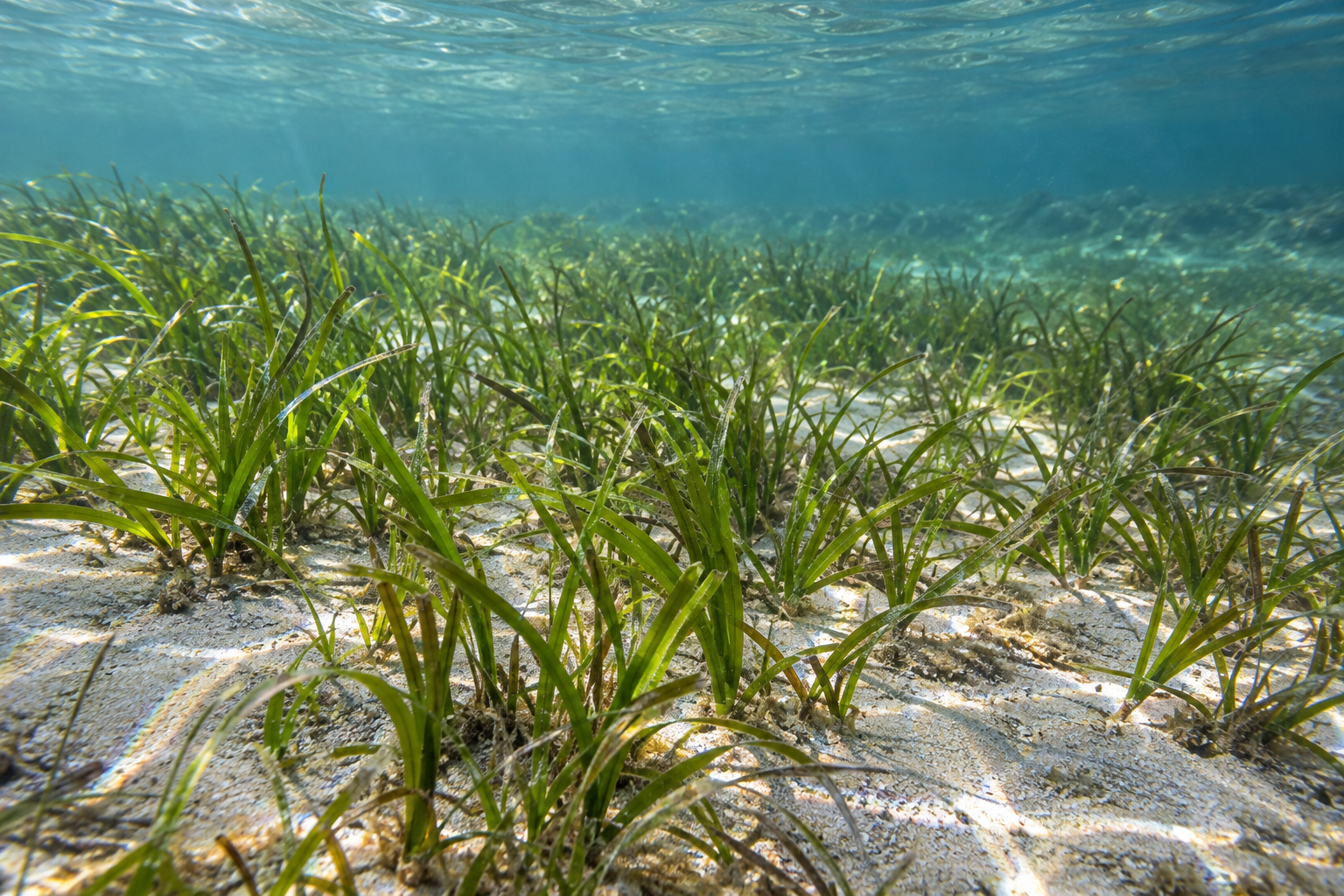
From above, a shallow bay can look bright even where its bottom is dim. Sunlight has to pass through every layer of water before it reaches the leaves of a seagrass meadow. The plants are rooted in the seabed; they cannot move upward when suspended silt or a bloom of algae steals that light. Their green leaves must make enough energy to support roots and buried stems as well as the growth visible above the sand. The question is therefore not simply whether the sun shines on the bay. It is how much useful light remains where the leaves actually live.
Depth makes the difference visible. In a study mapping seagrass and light across several Florida estuaries, researchers combined maps of plant cover and bottom depth with satellite, underwater-light, and Secchi-disk observations. The average depth of the occupied zone varied substantially among estuary segments: roughly 0.8 meters in Old Tampa Bay and 2.3 meters in western Choctawhatchee Bay. The fraction of surface light at the median depth of seagrass was also far from uniform. It averaged 18% in the Indian River Lagoon, 42% in Tampa Bay, and 58% in Choctawhatchee Bay. These are estimates at the observed meadow edge, shaped by local conditions and methods, not three interchangeable minimums for every seagrass species.
A separate Gulf-coast Florida field study of four species found light thresholds ranging from about 8–10% of surface irradiance for Halophila engelmannii to 25–27% for Halodule wrightii in those sampled systems. The authors found that their values differed from reports at other locations. Species, leaf form, and prior light conditions can change what a plant tolerates. A single percentage printed on a management chart cannot capture the depth, history, and species mix of every meadow.
Light lost in the water—and on the leaf
The water column can become a filter. Fine particles lifted from the bottom reduce light penetration, while nutrients can favor algae that intercept more of it. In the Gulf-coast study, seagrasses were absent at stations with higher total nitrogen, total phosphorus, chlorophyll a, and water color. That pattern points to a linked water-quality problem, but it does not prove that any one measured substance caused each empty patch. Depth, salinity, sediment, and other local conditions also govern where rooted plants can persist.
Sediment can do more than shade from a distance. It can settle directly on a leaf. In experiments with Zostera muelleri leaves coated in fine silt and clay, net photosynthesis in coated leaves fell to about one-fifth of the uncoated controls under the tested conditions. Microsensors found a thicker layer of nearly still water at the leaf surface, which slowed gas exchange. After dark, coated leaves took up less oxygen, and the researchers observed longer periods of low oxygen in growing tissues and intrusion of toxic sulfide. The study does not mean every dusty-looking leaf is dying. It shows why a clear measurement in the water above a meadow may miss a second barrier pressed against its living surface.
How long light is missing matters as much as a single reading. A four-week aquarium experiment with Singapore Thalassia hemprichii compared steadily dim conditions with fluctuating shade designed to resemble ship-wake turbidity. With similar average light in the two treatments, the constantly shaded shoots showed more stress, including reduced growth and below-ground biomass. Brighter intervals appeared to let the fluctuating group meet more of its daily needs. This is a result for plants from a chronically turbid Singapore site and a particular light schedule; it is no license for repeated severe shading anywhere else.
Long deprivation leaves a different mark. In an imposed-shade study of a Posidonia sinuosa meadow in Western Australia, shadecloth sharply reduced incident light for months. Leaf production on surviving shoots recovered relatively quickly after the cloth was removed, but shoot density remained below the control meadow through 245 days of observation. Longer shading produced larger losses of shoots and productivity. Clearer water after a disturbance can improve the conditions for growth; it cannot instantly replace the shoots already lost.
The meadow also changes the water
Established leaves slow moving water near the bed, and that can affect how much sediment is lifted into view. At a sheltered site off Western Australia, a two-week field study inside and beside a seagrass canopy found near-bed mean currents inside the meadow averaged only 35% of the speeds measured above it. Wave-driven motion was reduced much less. When sediment was stirred, some suspended particles remained concentrated inside the canopy. The meadow altered the flow; it did not turn waves off or guarantee uniformly clear water at every height.
Longer monitoring shows why this physical effect matters. In Virginia's coastal lagoons, researchers documented a large eelgrass restoration and its water-quality changes. As planted patches expanded into a meadow, summer turbidity measured within it fell, and comparisons with nearby unvegetated water of similar depth associated lower turbidity with seagrass presence. The team had broadcast seeds over years into conditions that could support their growth. The result is a feedback, not a shortcut: enough light helps a meadow establish; an established meadow can then help keep some sediment from clouding the water around it.
This is why clear water matters so much and why it is not the only test of recovery. Light must reach leaves at the right depth for long enough, and those leaves must remain able to exchange gases with the water. Species and sites set different limits; months of shade can remove shoots that brightness alone cannot summon back. A living meadow can quiet part of its own environment, but it first needs conditions in which its leaves can keep doing the work of a plant.
A thought worth keeping?