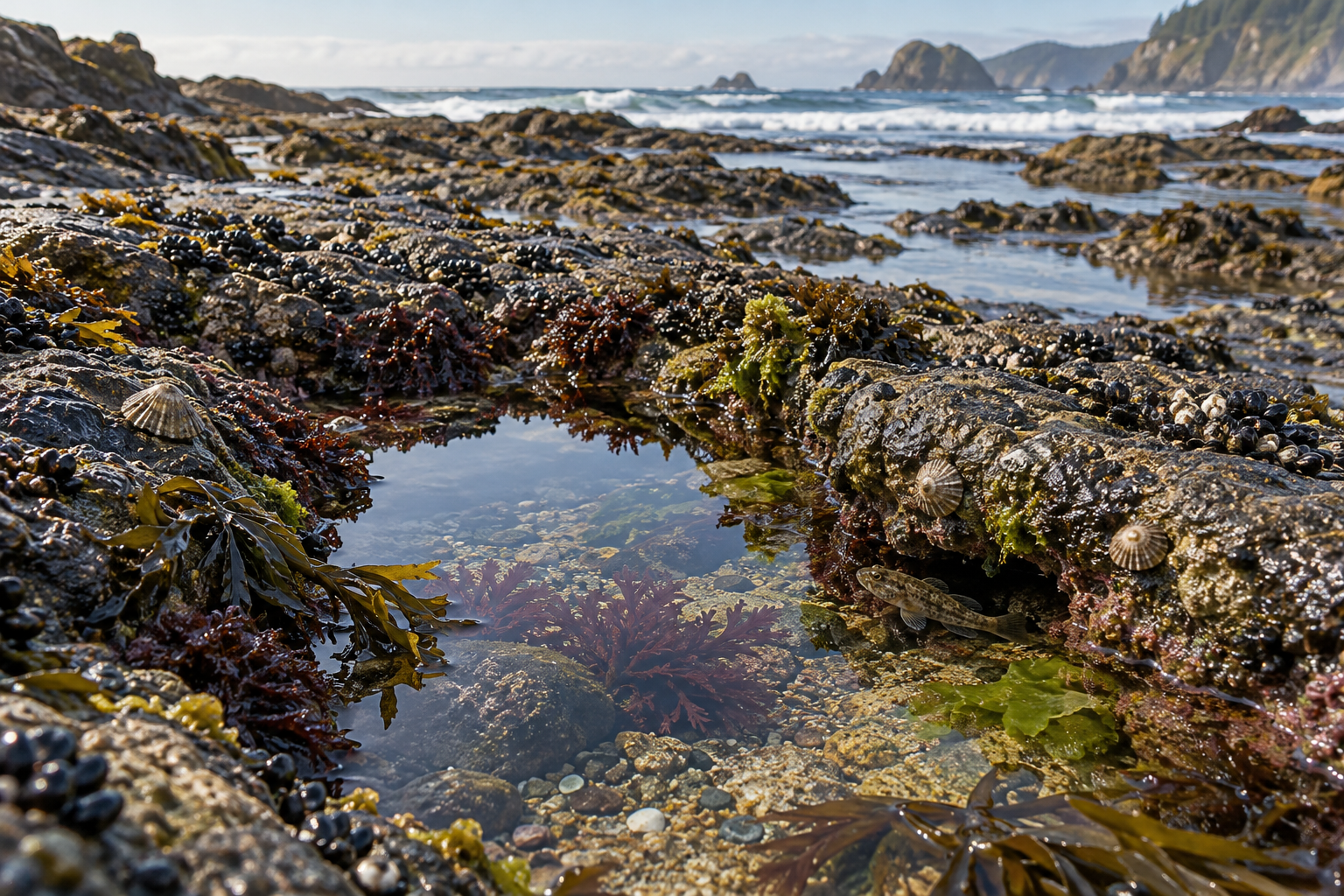
The sea leaves a tide pool in a hurry. Water slides off the rock, the surf withdraws, and a hollow that was part of a continuous coast becomes a small body of water with its own shore. A fish can still swim across it. A limpet remains under water. Neither is living in a little piece of unchanged ocean until the next tide arrives.
The pool keeps seawater, but it also keeps the consequences of being cut off. Sunlight reaches its algae without a current carrying their products away. Animals and microbes use oxygen. Rain can dilute the salt; evaporation can concentrate it. The rock and the water warm or cool at different rates. At high tide the sea reconnects the hollow to a larger supply of water and moving animals. Between tides, a pool has a short, busy life of its own.
A shore within a shore
Where a pool sits matters. A low pool may be reached by many tides or wave washes. A higher one can stay separate longer, leaving more time for heat, rain and metabolism to change its contents. Depth and shade matter as well, because a shallow pool exposes more of its water to the air and light for its volume. These are useful tendencies, not a way to judge a pool from its height alone.
Consider the fish in 18 rock pools at Los Cóbanos, El Salvador. Researchers sampled six pools at each of three shore heights, four times over a year, and recorded 48 fish species in all. About three quarters of the fish they counted were juveniles. Shore height, estimated pool volume and rock cover were the strongest variables associated with differences among the fish assemblages. The team classified some fish as permanent residents, others as opportunists that generally use pools when young, and a small fraction as transients caught by the retreating water. The counts belong to that tropical reef and that sampling design; they do not mean every pool holds that diversity. They do make the word keeps more precise. A pool holds animals with different reasons for being there and different prospects of leaving.
The rock itself adds habitat. A crevice can give a small fish a place to wait, while a branching alga presents many surfaces to tiny invertebrates. At two shores in north Wales, a study of animals living in Corallina officinalis turf identified 123 taxa within its samples. Assemblages differed with depth, pool size and shore height; the patterns were not identical on the two shores. The finding is about the invertebrates associated with a particular red alga, not a census of all life in a tide pool. It shows how much living surface can be folded into what looks, from above, like one patch of weed.
Daylight changes the water
Once the tide has gone, the organisms in a pool alter the water around them. Photosynthetic algae use dissolved carbon during the day and release oxygen. At night, photosynthesis stops while the community continues to respire, using oxygen and returning carbon dioxide. Those changes affect the water's acidity and the chemistry from which shells and calcifying algae build their hard parts. A still pool can make the daily swing unusually visible.
In four pools at Bodega Marine Reserve in California, researchers followed carbonate chemistry and community calcification through day and night. Their pools ranged from 17 to 39 centimetres in mean depth. Across observations, pH climbed from a pre-sunrise minimum of 7.22 to a late-afternoon maximum of 9.00. Nighttime net calcium carbonate balance was usually negative: more material dissolved than was laid down. The four pools differed in how strongly their chemistry swung, with depth, shading and the kinds of organisms present among the likely reasons. The numbers describe those pools and observation periods, not a normal range to expect in every hollow on every coast.
A later field experiment in French temperate rock pools makes the same point from another angle. In spring and summer daytime exposure, the researchers measured warming and a rise in oxygen as the community produced organic matter. At night, respiration drove a different course. They added carbon dioxide at the start of some low-tide periods to test how altered starting water would affect community production and calcification; their results included stronger nighttime dissolution under the added-CO₂ treatment. That intervention is not a forecast for every tide pool under future ocean conditions. For a reader standing on the shore, the immediate lesson is simpler: the pool's chemistry is partly made by what lives in it, and the hour of observation matters.
Weather can interrupt even that rhythm. A passing rain may lower salinity, while a hot, exposed rock can heat a shallow pool. At several Andaman Sea shores in Thailand, researchers measuring pools and nearby rock found wide ranges of temperature, salinity, pH and dissolved oxygen among the pools. Their measurements do not imply that all four variables always move together. Sunlight, rainfall, pool shape and biological activity each leave a different mark, and a single reading may miss the daily extremes.
Shelter has a cost
Water left behind protects animals that cannot endure being exposed on open rock. Yet remaining submerged is not automatically better for every shore species. The Thai researchers asked why two barnacles common on nearby exposed rock were relatively scarce in pools. Recruits did appear in some pools, but at lower densities than on adjacent rock. In their laboratory test, two weeks of continuous submergence reduced survival in one species, Chthamalus malayensis, compared with simulated tides; the other species, Amphibalanus amphitrite, did not show the same treatment difference. Heat and very low salinity also harmed barnacles in the experiment. The distinction between the two species matters: a pool can be refuge for one organism and an awkward place for another, even when both live within a few steps of it.
It would be easy to turn every low tide into a crisis story: the trapped water grows hot and oxygen disappears, so fish must escape. A 2024 study of 54 enclosed pools on Guam tested that idea with measurements and experiments on blennies. Some pools warmed sharply, but salinity, pH and oxygen did not generally deteriorate in the predicted way. Most pools stayed within the oxygen requirements the researchers estimated for the fish they studied, although low oxygen could help explain why blennies were absent from some. The Guam result is not a promise that heat or hypoxia never threatens fish elsewhere. It is a useful check on a tempting generalization: exposure creates possibilities for stress, while actual conditions depend on the pool, the day and the animal.
The next rising tide dilutes or replaces much of the pool's water and restores a route across the shore. It may bring food, larvae or a predator. The same hollow will be isolated again, but not with precisely the same mixture of life and weather. A tide pool keeps enough water for marine life to continue above the falling sea. It also keeps a record, for a few hours, of the rock's position, the sun's path and the work of the creatures within it. To read it well, look twice: once at the life it shelters, and again at the conditions that life is making.
A thought worth keeping?